Why Air-Gapped Security Is the Last Line of Defense
In a world of persistent network threats, the only truly secure device is one that never connects. We explore why air-gapped architecture remains the gold standard for protecting high-value secrets.
The Network Is the Attack Surface
Every device connected to a network is a potential target. Firewalls, VPNs, and endpoint protection add layers -- but they all share a fundamental assumption: that the device will, at some point, communicate over a network. That assumption is the vulnerability.
Air-gapped systems reject this premise entirely. By physically isolating a device from all wireless and wired networks, you eliminate the largest class of remote attacks. No WiFi, no Bluetooth, no cellular, no NFC. The only way to interact with the data is through deliberate, physical access.
Why Software-Only Security Falls Short
Modern operating systems contain tens of millions of lines of code. Each line is a potential vulnerability. Even with regular patching, zero-day exploits are discovered constantly -- and the most valuable ones are never disclosed publicly.
Consider the attack chain: a browser vulnerability leads to code execution, which escalates privileges, which exfiltrates data over the network. Remove the network, and the chain breaks at the final -- and most critical -- link.
"The only truly secure system is one that is powered off, cast in a block of concrete, and sealed in a lead-lined room with armed guards."
-- Gene Spafford, Purdue University
While Spafford's quote is deliberately extreme, it illustrates a real principle: security increases as connectivity decreases. Air-gapping is the practical application of this idea.
Real-World Air Gap Applications
Air-gapped systems aren't theoretical. They're used daily in the most security-sensitive environments on Earth:
- Military and intelligence agencies use air-gapped networks (like SIPRNet and JWICS) for classified communications.
- Nuclear facilities isolate control systems from the internet to prevent remote sabotage.
- Cryptocurrency cold storage keeps private keys on devices that have never touched a network.
- Legal and medical records in high-security contexts are stored on isolated systems to meet compliance requirements.
The Inklave Approach
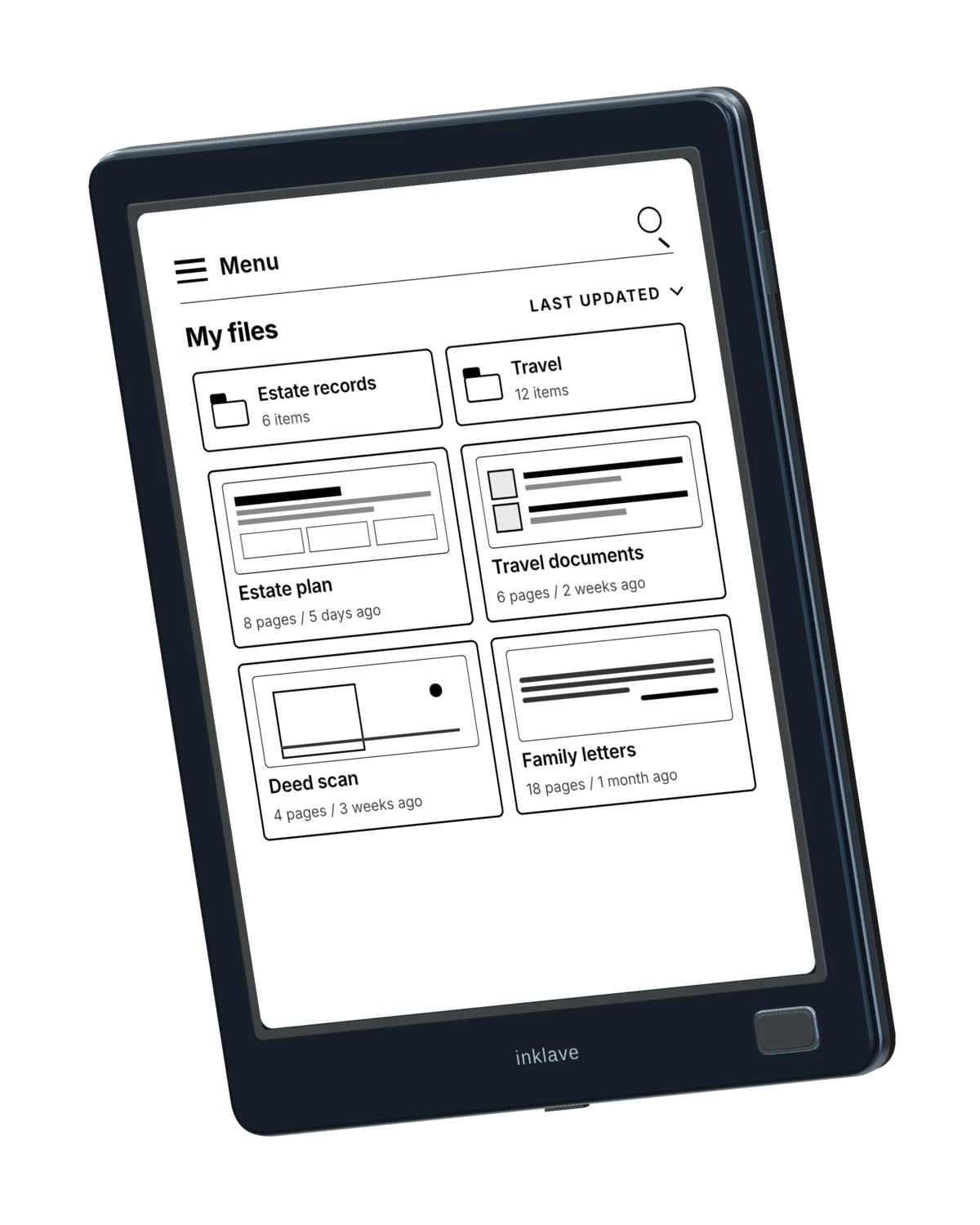
Inklave brings air-gapped security to individuals. Our tablet has no WiFi chip, no Bluetooth radio, no cellular modem. Data transfers happen only through the encrypted USB drive, with biometric authentication required at every step.
This isn't about paranoia -- it's about recognizing that some secrets are too valuable to trust to software alone. Your estate plans, seed phrases, medical directives, and business contracts deserve the same level of protection that governments use for classified material.
The Trade-Off Is the Point
Air-gapping introduces friction. You can't sync, can't auto-update, can't access your data from across the room with a tap. That friction is a feature, not a bug. Every barrier to convenience is also a barrier to unauthorized access.
The question isn't whether air-gapping is inconvenient. It's whether your most sensitive data is worth the inconvenience. For a growing number of people, the answer is clear.